
Aug 28, 2026 – Sept 26, 2026
Arts Council for Wyoming County
Good Evening. I am Krysta Aina, the Executive Director of The Arts Council for Wyoming County and we’re here to talk about the current exhibition with Tami Fuller and Ed Hallborg. This exhibition was born out of my head a year ago, really, because of the piece behind me. I had a light bulb moment and said, “I have an idea and I don’t know if you two will agree to this, but please do…”
And here we are. Norm Gayford has been kind enough to come and ask us questions about it tonight and we’re here in gallery with the artists, Tami Fuller and Ed Hallborg.
|
Norm Gayford (NG): |
The first time it’s been a collaboration between the two of you, is that correct? |
|
Tami Fuller, Ed Hallborg: |
Yes, that’s right.
|
|
NG: |
So the curator has done an excellent job in laying this out, hanging up, displaying, so the pieces look like they’re talking with each other. The pieces are not muted; not garish, but there’s a touch of color here and there. For the most part, they are just having a conversation. This has been my first experience of having the curator be a part of the collaboration so I’d like to hear about how that works with you. How does that work with you three? |
|
TF: |
I’m not sure how I contributed to this, besides the work itself. I can’t speak for Ed, but I consider Krysta really the functional lynchpin, as far as the exhibition goes. The work is Ed’s, and the work is mine, but the narrative and the conversation…I am not involved. I am a participant as much as anybody else and I love it. The imagination and the vision of it is entirely Krysta. |
|
NG |
Is this the first time you’ve seen it? |
|
TF: |
Yes, it is the first time I’ve seen it. |
|
NG: |
Ed, is this the first time you’ve seen it? |
|
EH: |
No, second. The first time I came in I was very happy. |
|
NG: |
Did you have more to do with placement than Tami? |
|
EH: |
No! No, it’s great. This is all Krysta. I know that certain pieces that I picked out… |
|
TF: |
So we did have a collaborative folder that we were considering – I would put work in that I was considering and Ed would put work in that he was considering and kind of worked against each other, you know, what works and what doesn’t work. We spent, I don’t know, how many hours on the phone trying to figure out the title, Ed? Right? |
|
EH: |
Yeah, the title was fun <good humored sarcasm> |
|
TF: |
Yeah. Once we did that, it was actually pretty scary. If it had been anyone but Krysta it would have been really scary, because there was no…control. <laughter from the group>. I mean, I dropped it off and I went…away. I don’t know if Ed had the same experience, but I thought it was great. |
|
EH: |
I was actually delighted with that aspect of the experience. I’ve had a few shows where I’ve been the one doing the hanging, so it was really nice to say, “Here, let’s see what you can do with this.” I think I agree that this is a better arrangement than I would have come up with. |
|
NG: |
Did you have any discussion in that folder along the lines of, “I don’t see that one going with this,” were you able to do that with each other…did you need to do that with each other? |
|
EH: |
We talked a little bit and yeah, I guess, for instance, these drawings. I really wanted to have a couple drawings that I’ve been working on, and Tami started coming back with…I can’t pronounce the word. |
|
TF: |
Suminagashi. |
|
KA: |
I’m going to have to hold to that, but I’m not going to remember that. |
|
FT: |
There was a conversation about some drawings that were very colorful. And I remember hesitating…worrying about sort of yucking on Ed’s thoughts, but I knew that those weren’t going to go with anything I have. So, yes, there was some sense of collaboration and vision between the two of us before dropping it off. |
|
ED: |
You know, one of the drawings that I brought over, they didn’t feel like it fit, either, so it ended up being pulled out. Which is great – having an editor is not a bad thing at all. |
|
KA: |
So while I did curate the exhibition, the exhibitions team did come out and help me install the show. Lou was wracking his brain trying to place it, and I had to say, “don’t you see that the problem is that this piece doesn’t belong here. It doesn’t belong at all.” It’s not that I thought it was bad: I actually almost bought it and took it home! But that was sort of me inserting myself into the show again, and I think that’s why everything flows so perfectly, considering how different the works are. |
|
NG: |
So, Krysta, you had help hanging but this is what was in your mind or developed in your mind. You’re an artist, I’m an artist, I understand how this works. You didn’t just have this in your head…probably. You were pairing things, and then repairing them, so to speak? Is that true? |
|
KA: |
Yes, so there were a few things that I knew as soon as I had it unpacked that belonged together. |
|
NG: |
For you. |
|
KA: |
Well, yes. Which really was the only thing that mattered. I was the one looking at the work, right? |
|
NG: |
So…I’d like you to choose a few pairings and talk about them, for instance – <points> |
|
KA: |
So, it’s so funny that you would choose those two. The “building,” and I can’t remember the name of Tami’s piece, but I immediately put them together. If you look around at the show, you’ll notice that there are only a few pieces that are situated that closely together, spatially. There wasn’t a lot of thought process that went into it. They just went together. <laughs lightly> They’re married now. |
|
EH: |
So, the rectangles, I see. |
|
KA: |
Yes! But it wasn’t really until afterwards that I thought about the actual shapes. It was just immediately, they just, they belonged. And Tami, while she works with an organic material, she really has some pretty architectural and geometric pieces, so in that sense, their work does work together. For instance, the colorful glyphs Ed has on either end, it was pretty easy to find pieces of Tami’s that spoke to them. |
|
NG: |
What are they saying? Let’s stay with that. What are those pieces saying to each other? |
|
KA: |
So, me as an artist, when I’m creating my own work…I am an intuitive painter. I tend to focus on color. If I were to look at this whole wall as a composition, I needed to sprinkle out Ed’s color throughout it equally; and then, the geometric shaped pieces of Tami’s work are mostly on this wall too. It’s like a little ball bouncing along the wall and then it sort of gets tangled up in the middle. |
|
NG: |
So, <gesturing> Locked, Loaded Disheveled there – has this projectible shape implied here or a “ball” that goes right over to the next and so on, and then it becomes absorbed within each other. I had to look at it to see that, but it’s there. Good for you! |
|
ED: |
I want to give some props here. This is a case where you and I talked about this, but besides this, you never suggested anything. You did really just take what we brought and staged it, the way you thought it should be staged, and it’s quite nice. |
|
KA: |
So you both said: when you dropped off your pieces, I received communication to use what I needed and leave out what I didn’t want. And I have seen most of these pieces, at least photos of them, but the idea that I was unsure of whether the work was going to be good enough or interesting enough was never a concern. So, thank you for making my job easier! |
On Shadows, Mythos, Propaganda and Wounding:
|
NG: |
All, another question for all three of you. One of Tami’s pieces is the only one that’s out from the wall – that’s bringing more dimension into this, with the shadow work on the wall. I see with Ed’s piece, the map on both sides, from sitting her in this perspective, the puppet echoes the shape of his piece, but also comes back here to another piece. The rather geometric candle takes us back to the rectangles here. It’s not just the gunfire and “balls” came out, it’s the shadow work. But there’s only one. Tami, did you submit more than one? |
|
TF: |
So…the shadows, I can talk about shadows. That’s a question that has more to do with install, I think, but I can talk about the shadows, that’s actually important to the work, but I would like Krysta to start about the decision with that piece. |
|
KA: |
So, I thought a lot about where to hang that piece – I’d seen photos of how Tami had it installed previously. And as most curators know, there is a certain matter of convenience that we sometimes lean into when we have to. There are a lot of hooks already installed in this ceiling. I didn’t want to put more holes in this 100-year-old beadboard ceiling. They were in the location where I wanted the piece to be, and then it was a question of whether I wanted to move them because I really wanted people to be able to walk around the whole thing. The way that it’s hung similar to another piece of Tami’s – I was very interested in seeing the inner workings of the piece. The shadow wasn’t there when I hung it – I created the lighting and the shadows after I hung it. It was more about connecting to Ed’s first piece there and wanting to connect this spiky sort of nature of Ed’s piece. I only had so many opportunities to make this connection and people needed to see it before they came inside. And quite honestly, I would have preferred it to be a little bit farther out there, but there were already holes in the ceiling and you work with what you have. |
|
NG: |
So, now Ed’s trees – you can see the trees…these trees behind Tami…you can see the lines in – I love this piece, I forgot her name? |
|
TF: |
Thank you. That’s In Her Presence. |
|
NG: |
Right. So you have the linearity there, you have the linearity of the almost western indigenous feeling in the companion piece, that all works together and when you have the lighting working on Ed’s piece, the shadows are speaking. |
|
NG: |
I love when air moves around and touches art. There’s an animation. |
|
EH: |
Yeah, Tami gets a lot of that in this show. |
|
TF: |
So, it’s a theme for me as well. <pauses, hesitates> So, as I do this longer and longer… |
|
KA: |
Live? |
|
TF: |
Ha. Live. Yes. |
|
KA: |
As We do. |
|
TF: |
As we talk about it and I get farther and farther into my process it starts to feel almost strange to talk about why I do what I do and I’m not sure I’m as connected to it as i was when I first started, but my practice does revolve around reclamation and sexual assault and pedophilia survivorship. So, most of the pieces that you see me ripping and tearing have to do with exploring the concept of self. So, the pulling apart – the getting at the root of something that’s inside – of pulling up that shadow and exposing it to the light…understanding it – not letting it take over you or control you or not…to be in active reaction to it, but rather to work with it, much like a weaver. There’s an execution and a delicacy, almost…a surgical component of weaving. If you’ve ever watched a weaver really get into a pattern that sentiment is there. So, the pulling up and out of things so that they can be exposed and then leaving those tendrils that hang so they can still relate and react to their own environment is part of the work. It’s meant to respond to where it’s situated because you never stop responding to it. No matter how good you get at negotiating with those things, it never actually heals. It’s always a quivering sort of shadowy thing that you have…it’s like an uncomfortable roommate that you’ve gotta work with. |
|
KA: |
So, I have a background in mental health and I do a lot of art therapy programming here. The process of weaving really requires mindfulness, which is something that really helps process trauma. So it makes sense that you’re a weaver. The act of doing something so meticulous and then sort of undoing it is a next level of being able to process and work through things. |
|
TF: |
Yes, exactly – like a dissolution of self. |
|
NG: |
So I have a question for you: How close in your mind is Penelope? |
|
TF: |
Oh! From Odysseus/Odyssey? I love that question. |
|
NG: |
So she is processing such a loss of such a variety of kinds and then dismantling it at night. I thought of that immediately…. |
|
TF: |
So delicious, right? There are so many motifs and metaphors that have to do with weaving. I’m convinced that the character of Penelope in the Odyssey…so, it is a mechanism. She isn’t a person. That character isn’t an actual person…it’s a motif for something that women have understood since, well, clearly, the dawn of time…is that the things that we do in the dark are meticulous and they serve a purpose and you have to constantly come back to them to properly understand ourselves. There’s power in pulling apart and getting to the bottom of something. Really, sometimes you have to do something over and over and over again until you get to the heart of why you’re doing it, so there’s like this repetitious quality that this story evokes… almost…if you don’t do that; if you don’t take it apart and then go back to that same crucible and do it again until you understand it, it feeds into neurosis, right? It takes on a life of its own. It’s like a constant concert with something that needs to be worked with, so I love the story of Penelope. |
|
NG: |
It doesn’t surprise me that you do, because in one of the other pieces you mention Chiron, the failed healer. And I thought of Arachne, which the patriarchal system batters utterly. Basically, what she’s doing is telling the truth to the Goddess but the Goddess doesn’t want to hear it, so she turns her into a spider, to practice your weaving with the humility you should. There’s that, you know, don’t speak up, don’t talk all the way through ancient mythology, so that’s what I see in your work. |
|
TF: |
So, we don’t have time to properly unpack this tonight in the way it deserves… |
|
KA: |
Or, ever. |
|
TF: |
<laughs>. Right. So you have to remember, whenever you’re talking about the Greek myths that we’re talking about, like Arachne, and even Odysseus…cause it’s not real: it’s song, right? It’s ancient. It’s probably Neolithic, like back, back, way back. Realistically, like back… that way back all of those mythos are just patriarchal shells that were laid over even deeper, older stories that were rooted in matriarchal and feminine power, so a lot of those stories that we see are deliberate bastardizations and deliberate hob knobbing of female power delivered through the power of song and propaganda. So Arachne is really an interesting story. |
|
NG: |
It always comes through. |
|
TF: |
Yes, it does always come through. It’s the spider! Spider energy is a powerful, powerful medicine. We weave in the dark and then it comes out to the light but it’s always there; it’s always happening, whether you’re keen enough to see it or not. There’s a power and a magic to that. |
|
TF: |
I love the Chiron piece. I don’t want to monopolize the conversation… |
|
ED: |
No, it’s interesting to me, I’m listening. |
|
TF: |
Ok, right. So this Chiron piece…this is the first time a curator has chosen to display it…<struggles> backwards. Which is uncomfortable for me. |
|
KA: |
You’re welcome. <group laughter> |
|
FT: |
Thank you so much /s/ I do think that as artists, we can get way too close to our work and it’s really really important, especially if you’ve been doing it for a long time, and you really know your story, that someone comes along and you can give over your creative control and someone can defy that and make you uncomfortable. In myth, Chiron is the wounded healer…he was a centaur – an immortal being – but was cursed with a mortal wounding. It should have killed him, but he couldn’t die, but he also couldn’t heal. It’s like a constant, sort of festering curse. |
|
NG: |
It’s like the King Arthur story; the wounded king. |
|
TF: |
Yes, it’s exactly like the wounded king. It’s a very old story. And you’ll find a lot of those old stories like that echoing around cultures. If you get into Joseph Campbell, it’s everywhere. The point of Chiron is that he owned the damage; instead of letting it overtake and poison him and put him into a place where he was useless, he instead projected that outward and put his life purpose into healing other people. So there’s a lesson in that piece, because that piece is ugly – it’s irredeemably ugly but it is really, really beautiful at the same time – there’s something to it. It is an unabashed disfigurement: there’s a pride and there’s a power and there’s a poise and a dignity to that piece that comes through in spite of the aesthetic. That piece is a twin to this beautiful install Krysta did that we were just discussing a bit with the shadows. These were actually created together and are intended to be displayed together as a relational diptych. That is the Weight of Hidden Things. The Weight of Hidden Things has to do with the different sort of disfigurement that comes with burying secrets; not owning your disfigurement or not coming to terms with what it is that you’re carrying…and holding it and pretending that nothing is wrong. It has a weight; it takes its toll on you. It creates Shadow. And in turn, if you fail to come to terms with it, it makes you vulnerable to manipulation and predation by other people because you’re putting all your energy into holding a facade instead of reclaiming and holding onto who you really are. |
|
NG: |
Hence the Marionette. |
|
TF: |
The Marionette. Yeah, that took a long time. It took about three years to fully flesh out that idea. The way that Krysta has installed it is great. If you haven’t already made this connection, I hope that before you leave you go around the backside of it and look up and confront it. I know that it wasn’t an intentional choice to hang it that close to the wall, but what she has done with that installation is, she’s created a deliberately confined, uncomfortable encroachment on your space, so when you look and you confront that, you do feel trapped with your back against the wall, and it really is a profound moment where you can’t escape from it. I’ve just fell in love with that piece all over again tonight because of that install. |
|
NG: |
All right, now. I didn’t know this. Krysta, you chose to turn [Chrion] around. |
|
KA; |
I did! As I was unpackaging it and I held it up and you know, turned it over and saw the insides of it. This is the most interesting, uniquely my way to look at the piece, because this is all the things that no one should see – and I manipulated it so you could see into it as much as you could. |
|
NG: |
[to Tami] And you wanted to push back on that for a moment, but you didn’t. |
|
FT: |
I didn’t push back. |
|
KA: |
That’s the first thing she said to me, “Did you hang that backwards on purpose?” I did! I needed everyone to see what I saw. It told the story for me more easily. |
|
NG: |
This speaks to me of the ugliness but the sheer unavoidable presence of a mask. There is mask face in that. |
|
KA: |
I see the open wound. |
|
TF: |
So, from a purist perspective, “artist’s vision” perspective, that piece is intended to be viewed front facing and that cross bar is meant to be on an angle. It’s strung on the original warp that it was woven on so the way it’s hung is like a female torso. And it’s beautiful; there are veins and ribbing that run through it…and from the back – and I can’t unsee it – and I love it – it looks like a side of beef in a butcher’s cooler, that I really, really enjoy. It adds another layer to the story! |
|
NG: |
How do you feel about that? |
|
KA: |
It felt…meaty to me. |
|
NG: |
Were you tentative about that decision? |
|
KA: |
Oh yeah. I was fully expecting to have that conversion as soon as she saw it… |
|
TF: |
I don’t have any control issues; I’m fine. <group laughter> |
|
KA: |
I changed this one for her [points to Writhe]. It was strung when she delivered so it was completely level and I showed her a picture of it. And she said, “I know why you did that, but it really should be tilted.” And I came back and I…she was right. I gave her that. |
|
NG: |
Were you aware of any of this, Ed? |
|
EH: |
No! I had no idea this conflict was going on! I don’t think there’s anything that would be open to interpretation in my work…I mean, I suppose this could be backwards, I suppose. I mean, if you took a piece and put it face against the wall, I would be like, wow. That’s a pretty strong curatorial statement there. |
|
KA: |
I did turn it around.. I thought about turning it upside down but I thought that would send the wrong message if the bird was falling down. It’s exactly how it should be. We changed the pedestal situation several times…we had a couple different pedestals. I like the addition of the empty pedestal between the two. It adds depth. |
|
EH: |
Yeah, yeah. I like that. |
On Interaction, Interactive Art, Collaboration:
|
NG: |
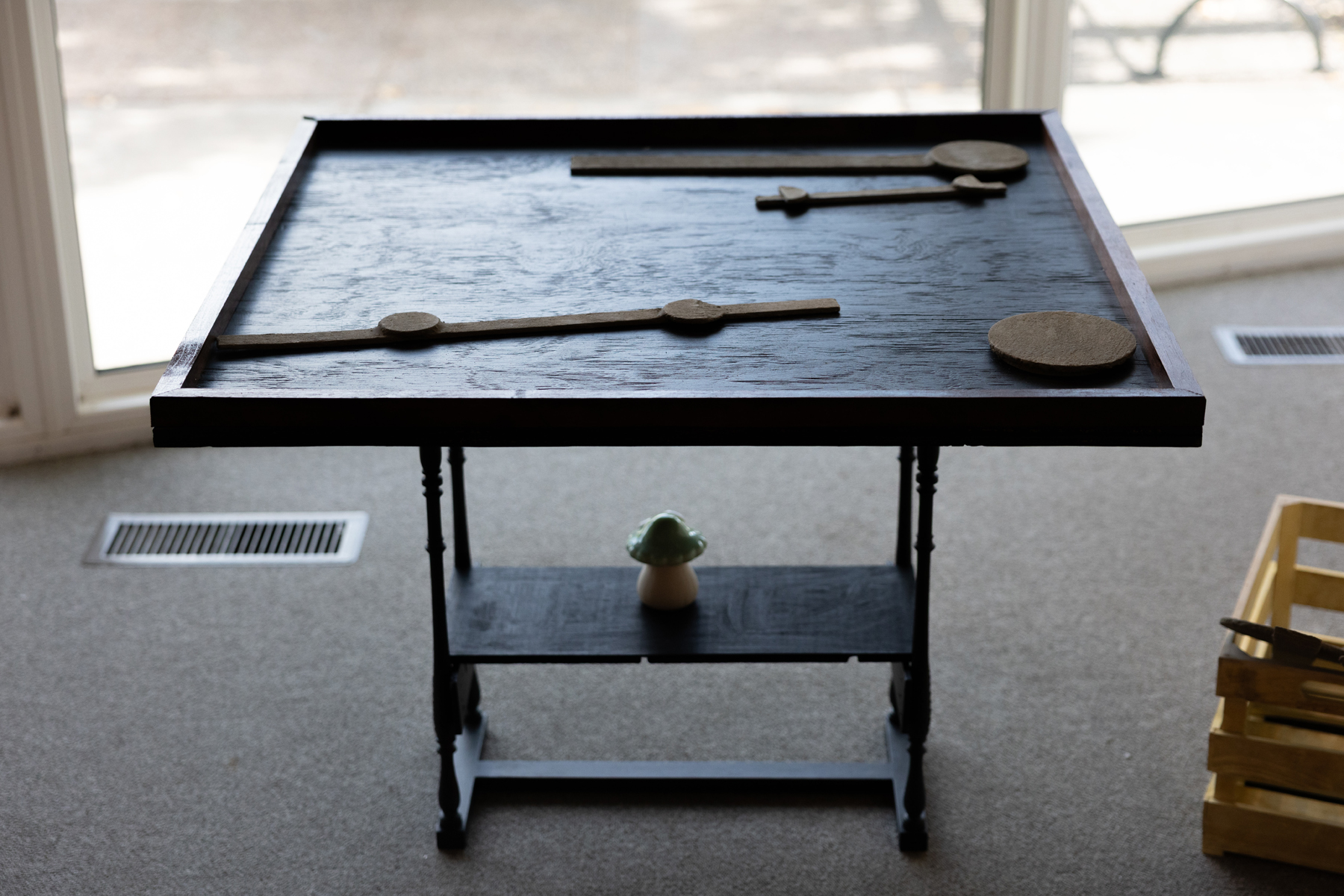
But you also chose to put the interactive piece in the window. Ed, what’s the title, again? |
|
EH: |
Oh. Collaborative Piece #3 – it’s pretty simple. It is the third one. All three of us worked on part 1, and there’s a second piece at home on the wall that I collaborated with my wife Amy on. And the third one is this one here. |
|
NG: |
Have seen any photos of it being interacted with yet? |
|
EH: |
About two weeks ago we were here…there were some littles working on it. I mean, I know that adults don’t generally go over and start playing with toys. I want everybody to try it out! It’s interesting to see what happens to it. But the kids they just…they don’t even look at the rules I’ve got up, they’re like, whatever. The rules are sort of to encourage people; hey, this is a way to approach it. You don’t usually walk into a show and start playing with things, obviously. |
|
KA: |
And adults need that prompting. The rules are really just a way of saying, “it’s okay to touch this, grown ups.” |
|
NG: |
So, Ed, is there anything oracular in this? Is there anything that you hope some messaging comes out of it from somebody playing with it. |
|
EH: |
Honestly, no, I think that’s strictly about design, it’s about composition. |
|
NG: |
Do you have a favorite? |
|
EH: |
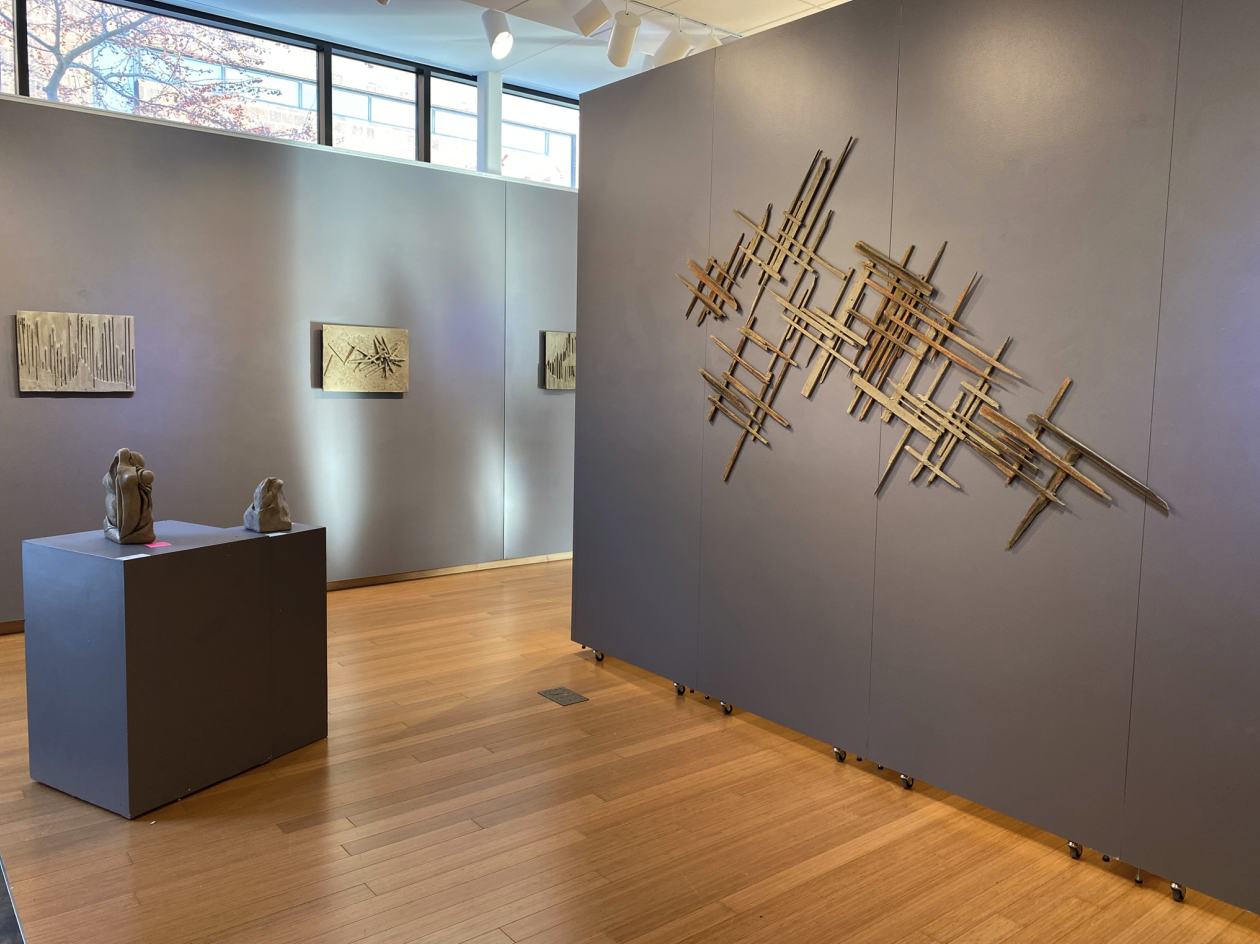
I took some pictures of the one I made, but everything I’ve seen I thought was pretty interesting. I just like to see what people do with this! This show for me is very different – I don’t know why, but I really embraced the collaborative nature of this show. I really wanted to see it. This was a last minute thing it was like, what can I do to really go with the collab thing. I had a grant in here a few years ago that was also a collaborative grant with kids – up to 10 years old. I had pieces that were like these glyphs over on the side here – with no color on them – and we gave the kids a couple hours and some acrylic paint So that’s kind of where the collab work started for me. |
|
KA: |
That was the first work of yours I saw, right after I started. And in that situation, you completely installed the exhibit by yourself. And there was a collaborative in that as well, you brought it. Oh…and now I’m remembering that we were going to put it in this show but it’s still upstairs in our permanent collection. |
|
EH: |
I can kind of button this up, I think…so the reason this comes out: I happen to work in theatre and theatre is all collaboration. It’s something that’s sort of engrained in me…I don’t even like that aspect of theatre, honestly. I like to make decisions! But it’s really there and a big part of that. |
|
NG: |
So when we were both working at GCC and I was directing children’s theatre shows and Ed was the technical director and thus, the lights…I’ve never had such fun collaborating with a fellow adult. But we would spend hours: I would put him through hell. I would show up and we would spend a whole day – what it felt like was painting with light. And he would suggest something and I’d say I don’t know and I’d suggest something and he’d say yeah, but you don’t want to do that, and we’d just end up having extraordinary fun. We both wanted the emotional effect, and we both wanted the aesthetic effect. So don’t tell people you don’t collab. You do! |
|
TF: |
Collab is so important. |
|
KA: |
I think collaboration is such an artist thing to do. At least for me, growing up in a rural community – trying to find your people is so difficult when you’re the one weirdo in the class. There aren’t many of us! So when you find somebody whose brain works like yours…my favorite time of year is when Tami and I install Fiber Flurry together. We probably annoy Tom because we’re loud and obnoxious and laughing… |
|
TF: |
…laying on the floor…. |
|
KA: |
He’s grown to tune us out. |
|
FT: |
That’s fair. Survival. |
|
KA: |
But when you have the opportunity to connect your brains in such a way it really does make you feel seen by other people. It’s like we’re a team of superheroes. |
|
TF: |
Actually, I’d prefer to be an anti-hero if I have to do superhero tropes. |
|
TF: |
I think that being an artist is fundamentally a very solitary experience. We spend so much of our time, even when we’re with other people…uh…very much encapsulated in the inner world, because otherwise you don’t get any spark and you can’t create. So there’s a contradiction – that tortured artist trope takes on so many forms. So I think you’re right – we have to collaborate. And it is not comfortable. Sometimes it sucks. It’s hard because you get challenged and you have to defy your own need for control. It’s really, really good for you. Artists are social creatures; we need the other humans, but we really don’t want to deal with the other humans! So collaboration is a great way to scratch that itch. |
|
EH: |
True. |
Building Worlds and Words, Editing Each Other and More Shadows:
|
NG: |
So, now that we’re all comfortable, what would you do differently with this installation if you had the chance to reset it for one more month? |
|
KA: |
Ha, uh oh. Tami… |
|
TF: |
.I actually love it. And I am going to sit with that love until it feels natural..cause it’s good for me. I was just thinking, there is one thing – one thing I would do differently…the tree piece behind us. I was an O.M. kid – does anyone here remember O.M.? Odyssey of the Mind? Every time I see something tactile that requires some sort of component work – like, I look and there’s this weird, like, how can I build it. If it were me, I would build a support to sit and be stable in the pedestal and I would turn the pedestal so it was out in the space of the room so it was kind of a screen so you get a sense of looking…looking through it. I think that’s a really cool piece. |
|
EH: |
That’s a great point. I hate to say this, and it’s not romantic at all, but the thing is…I always think about this stuff, where I’m like, I have to move this damn thing. This is what happens! <group laughter and artist groans> I did think about that, it would be great to have a self-supporting thing but then I have to build it or move it. So, I might be coming back to that. |
|
KA: |
I did really consider putting that in the window, BUT… |
|
TF: |
No. It’s so good right where it is. |
|
KA: |
Those two pieces needed to be together. That was the first thing I said – they need to be together. As soon as I had everything laid out, they were talking to each other, they needed to be neighbors. |
|
TF: |
This piece here, In Her Presence, it’s kind of like oracle/dark void…there’s this song by Eartha Kitt…if you’re a Kitt fan…Woman, Woman, Woman. Nothin’ but a hank of hair…there’s this line that she’s nothing more than a hank of hair, right? It has all that visceral misogyny buried into it, so I was really thinking about it…and that piece of wood is actually a reclaimed church pew. So there’s this kind of holy reverse narrative on the sacred profane that’s happening there. I’m a naturalist, not Druidism, really, because that’s become kind of hackneyed, but you know, adjacent, so the thought of like the sacred grove situation with the trees and very, like horned god, Bacchus, in the woods sort of situation – and I really love how that marries together with the placement with Ed’s tree piece. |
|
NG: |
Ok, I’m going to play a guessing game and I want your reactions. I love wordplay, I love poetry…you couldn’t have had a more slow down and read it title. So I’m going to guess that Tami went for the middle, because I’ve seen her use the bracketed hyphens, and I’m going to guess Ed did excavations and you, Krysta, wanted intersections. |
|
KA: |
So, OK, we talked about names right off the bat and there was a lot of talk about deconstruction, decomposition, architecture, intersections, and it, it became a very involved conversation. I was like, you guys need to figure this out on your own – I don’t know what to call it. I think we were on that zoom for like, two hours. We were supposed to be talking about logistics and timeline and half of it was name. So I’m going to give Tami all of the credit for that. There was a lot of back and forth, but it was automatic. |
|
TF: |
So, real talk, we did that again on another marathon later. We were talking about the architecture of the moment and we were worried that it would feel too charged with everything that is happening but there is this wonderful conflict, because Ed’s work is so very male, and monolithic and hard and severe. And then you have this similar severity but approached from the organic female perspective, so we were really enjoying the thought of leaning into like what’s happening with bodily autonomy and female rights versus human rights, what made all of those conversations…and in the end, we were like, WE know what’s going on but maybe we don’t need to pull the council into that conversation….maybe not the place or the time. So, we went back and forth a lot, like architecture and decay…to be perfectly honest, I do feel a little bad, I may have gone a little deep end on that name. I keep forgetting the title. |
|
NG: |
No, this slows you down. It makes you think: the minute you walk in the door, especially if you’re a text oriented person…excavations, buildings, spaces excavated for buildings, and the glyphos that you do. And decomposition, unraveling things but with such purpose. And decomposition is sometimes less purposive, so it makes you wonder about the ambiguity of that. And intersections, of course, the collaboration. You did fine. |
|
EH: |
I’m just going to say one more thing about this. You alluded to this, but I must have had at least ¾ page of titles that I finally just tossed it away – there were some really good ones…some zingers. |
|
NG: |
But what you didn’t do is give it to ChatGPT and ask it what to call it. |
|
ALL: |
No, Never. Never. |
|
From Audience: |
This is directed to Tami, given the background that she’s disclosed, I couldn’t help but think of the crucifixion and the three crosses in the shadow install – is that intentional? |
|
TF: |
It’s not. So that is something that Krysta created on her own. |
|
KA: |
With the lighting. |
|
NG: |
Did you intend three crosses? |
|
KA: |
I stood on the ladder for quite a while creating the lighting and it wasn’t necessarily intended to be three crosses, but it was the composition that was the most interesting and appealing for me. My brain doesn’t tend to go to religious iconography. |
|
TF: |
I’m virulently anti-religious. I was raised in organized “faith,” and I reject it profoundly, so that’s a really interesting connection to make, and I really did not see that before, so thank you. Lots to think about. |
|
KA: |
There are only two crosses and the third is created by the lighting. The lighting is the most overlooked and hardest part of a show. Not just because we have to climb on the 12 foot ladder to do it, but especially with Tami’s work and sculptural pieces in general, making sure it’s properly lit and not casting shadows that affect the work around it…it’s a real challenge. It’s not just about lighting every piece for brightness. It’s making sure it’s casting an interesting shadow. When I started it was shadowing [Ed’s] pieces in a way that wasn’t attractive. |
|
NG: |
That’s what we were talking about before with the stage. So you don’t want the intuitive stuff to go on. What you did with this piece going on, it animates it – it could have been just a phallic candle standing there. But it’s also, okay, there’s more than one key. There’s more than one thing being said. More than just this upright thing. |
|
KA: |
So, when we install a show, we can’t light it during the day. So we’ll usually start lighting around 4. So for this show I left the ladder out and changed some things around before I left, because it wasn’t right yet. While there’s a lot of levels in that piece, I couldn’t light it in a way to show that dimension so I needed to show that in another way…so creating all those shadows made it connect to Tami’s piece; the color is really speaking to this piece on the left but the piece on the right, the shape and the shadow is what I thought was speaking. It’s weighted in the same way. |
|
EH: |
It really is. I really love how it’s coming off from the wall so it’s not a flat present and the shape and the shadow really is this wonderful. It’s a really very powerful presentation of the whole wall. Really. The more you look at, for instance, how the light hits the components of Ed’s piece, it brings out where the roving creates the pits and shadows and brings [Complicated Landscape] alive in a new way. |
|
KA: |
This side of the wall is so much more about the lighting and the structure of those pieces and how they’re built whereas this side of the wall is more about the composition or the shapes within the pieces themselves. Except for Tami’s one piece down there, there’s really some interesting shadow stuff happening – the new one. |
|
TF: |
Empirical Forma. |
|
NG: |
So the shadow on that is really interesting to me. |
|
TF: |
Well, it’s four parts. It’s revealed itself. The framing behind it and then there are two shadows behind that. |
|
NG: |
What is that material? |
|
TF: |
The board is royal ebony. It’s from the Katalax tree from North Africa. I veneered that myself (with help). I could tell what that piece is about, if people aren’t completely sick of hearing from me. I always feel uncomfortable – I love artist talks because I never talk about my work, but then I feel like an overly excited 9yo. |
|
EH/KA: |
Go for it. |
|
TF: |
So every piece has a story, right? That particular piece is probably the first new piece I’ve made in maybe a year and a half – I’ve been doing so much admin and curatorial work I haven’t been able to be in the studio – and that piece was created in January, right when Epstein broke. I had already been quietly incubating a piece, because I had an invitational coming up that needed a new piece, so it didn’t just birth like Athena from the, you know, god wound or anything, it was already quietly humming…but that sent news cycle me into a complete downward spiral in ways…you often think you’ve been doing just fine until suddenly you realize you’re not and you haven’t been and then you have to clean up the mess. Right? So, there was that moment going on, there was a purging and processing and one of the things that was coming up when Guiffre’s book broke was the concept of the suicide, right? There was all these things coming out is…and it occurred to me one – of the things that we grapple with when we are excising those sorts of wounds is you reach a point as a woman survivor in your middle age where you, depending on how much work you’ve done consciously on your wound, you know you come to that place in different various forms, but you reach that point where you realize, this is the reality. Actually, NEVER…you’re never going to heal this; like, you can say that all the time, intellectually, sure, until you reach a point where you really get the gravity of it, is that “I will never make this go away.” It’s built into The Crucible, like, it’s it’s there, right? And I think that for many survivors, there is a terminal age in middle age where we see we do see a stark increase in suicide rates. Many adult survivors do not survive. They may live functional lives as adults, but you reach a reckoning where the full gravity really comes up on you and some of us don’t survive it. So as I was contemplating this it occurred to me to wonder, are there statistics? I was kind of grappling with that thought. It occurred to me to wonder about their statistics because I am a scient person; I went to school for genetics, you know, I’m a science mind – like, are there statistics to support that supposition? So, by the way – putting that into an internet browser is a terrible idea. <grimace, wry humor> You get a lot of stuff you don’t need to talk about. But ultimately, and to my disgust and anger, there aren’t. There are no actual studies or populated statistics that have to do with the study of female adult survivorship suicide rates. Which stands to reason; up until Me Too we didn’t even really talk about it. And we’re still grappling with dispelling some of that stigma. There are many people who are still violently opposed to having these conversations when they come up – which is why I’m having this in a populated space! So, I’m very sorry, but these are important conversations to have. |
|
KA: |
<interrupting> Don’t apologize for that. |
|
TF: |
Thank you. What was actually given very, very, very concentrated attention was tracking recidivism in adult female survivors to see if they would become monsters themselves, which I thought was absolutely abhorrent. It’s just such a statement on our priorities of a culture to dig into the heart of a complicated question and land there. So the name of that piece is Empirical Forma. It has to do with the latin origins, entomology, back in the middle ages, the beginning of pharmacology, the “forma” where we first developed the thought of how to treat things with calculated substance and then that weight of lived experience, that empirical data. And how that empiricism informs who we are. And that sense of mass, poised on the edge of something – you can’t tell if it’s a swandive or a jump, but something has to happen at some point. So what we put into something is what we get out of it. That piece is very near and dear to me, and it’s one of the first truly technically, statistically based overt story telling pieces that I’ve created. All the rest are very poetic and subjective, and that is a Thing. That is saying a very specific thing. And it won an award,in July! |
|
NG: |
Congratulations! |
|
TF: |
Thanks! I love the fact that you’re seeing the shadows. It’s a very important part of what that piece is trying to say. |
Capturing, Basquiating, Professional Growth and Boredom
|
TF: |
So I want to point out that I’ve admired Ed’s work for a while. I’ve admired his work for a long time and we’ve worked together before, not collaboratively, but through my work with RALA. I actually selected Ed as a Roycroft Emerging Artist in 2024, precisely because I really admire the construction that he’s putting in, like you see a lot of people that are casting with cement or they’re doing bas relief, but you don’t see it done in this way. I’ve always thought there’s almost a like Sumerian component to his work that I’ve always enjoyed. Like the neolithic storytelling myth and the thought of bringing that in. We’ve talked a lot about my work tonight…I’m on a prednisone prescription, so I am very, very excited about everything and I had a cup of coffee before we started, and that was not a good idea. So I’d really like to hear more about Ed’s work tonight. Ed, Do you ever get bored with your work? |
|
EH: |
Yes, but that’s why, for those of you that have seen my work, that’s why there’s color now. That’s why for the first time I have an actual 3d piece not on the wall, so those are things I’ve been playing with. |
|
TF: |
I ask because I do find I get bored with my work. Lately, I have felt really bored with my body of work because I haven’t been producing as many new pieces. I’ve been living with these pieces and they feel static for a very long time. Because I work deliberately in black and white, part of survivorship and traumatic processing is, unfortunately you can develop this very black and white mindset; we refer to it as black and white thinking, it’s very extreme; nuance is a dangerous place for survivors. So working and marrying those two together is part of the process, but you get bored. And I have to tell you, this triangle pairing with these two pieces that have been in my sight line all night has completely re-enlivened [Sublimate]. It’s really, really, really good. |
|
EH: |
It is! |
|
KA: |
Oh, that just made my day. |
|
EH: |
It is about the presentation. So, I reached out to Tami separately – I struggle to photograph this stuff, and it is all about the lighting. |
|
KA: |
I can have your work photographed while it’s here. |
|
EH: |
That’s great. Thank you. Even in my home studio I have multiple lights and I have them on dimmers and sometimes it’s great, but it’s really about presentation. You can make something very flat with a bad photograph. I reached out to Tami because I know you’ve had some work photographed professionally. |
|
TF: |
Yes, I’ve started to pay for professional photography. I tried to jury for NAWA last year, down in Brooklyn; the National Association of Women Artists – cause you know, I like, I like pain. It was painful! And they rejected me. But not because of the work itself, which was both encouraging and frustrating – they said that my body of work is very strong, but my photography sucks, and without proper photography, I can’t hope to jury. So I think that you’re right; you do reach a point with a practice, if you’re doing it with intent and you want to approach larger conversations, you reach the point that the amateur setup in the studio just doesn’t cut it anymore. But bringing it out into the light like this and seeing it in conversation with other pieces gives this wonderful new light. |
|
KA: |
I want to revisit this idea of being bored with your work. As a painter, that’s a very dangerous place for me to live in, because I tend to take things off the wall and gesso them immediately. I’ve had to make apologies to people for painting over paintings that I’ve given them, because if I go a long time without working, it’s the alternative to cutting your hair post breakup. I need to change something right now, and I don’t know what to do, but I can change that! |
|
EH: |
You took a piece back… |
|
NG: |
In the middle of the night! |
|
KA: |
I took a painting off the wall in my ex-husband’s office. |
|
TF: |
You Basquiated his painting!? |
|
KA: |
I did. |
|
TF: |
That’s great. |
|
KA: |
The new name of the painting is An Apology. He did like the new version of it. It’s also been painted over. Post divorce – I keep the art. |
|
TF: |
Thank you Krysta for holding on to the thread of this and making sure it happened. It’s so much more than I expected. |
|
KA: |
Thank you all for listening and for seeing it! |